
Kappo Kappo — Two Evenings I Didn’t Expect to Matter This Much
I ended up having almost the same tasting menu at Kappo Kappo twice within a few weeks.
The structure was familiar, many dishes repeated, a few changed slightly. And yet, the experience didn’t feel repetitive at all. If anything, the second visit made the first one clearer — like rereading a book and suddenly noticing what you missed the first time.
These two dinners stayed with me in a way very few meals have in recent years. Not because they were perfect. But because they did something much more valuable: they made me want to go back to my own kitchen and try again. Try differently. Reopen things I thought were already finished topics for me.
For someone like me, that’s the highest compliment a restaurant can receive.
What Kappo Kappo actually is
They describe themselves as a French-Japanese tasting menu restaurant, built around an intimate chef’s counter and a constantly evolving menu. Twin chefs Gohei and Haru Kishi, born in Paris to Japanese parents and trained in esteemed kitchens around the world, cooking directly in front of you, explaining each dish, answering questions.

All of that is true. But what matters more is the feeling: the entire dinner unfolds like a conversation. Not a performance or a lecture, but something in between.
As a culinary term, kappo means "cut and cook." It is a dining style with multi-course meals (omakase) prepared at a counter. “Kappo” itself, interestingly, comes from words meaning to bring back to life — techniques of restoration. And in a way, for me personally that felt accurate.
SAKIZUKE — GOUGERE
parmesan crust, nori emulsion, A5 wagyu + toro tartare, osetra caviar

The opening amuse-bouche was a gougère with wagyu and toro tartare, caviar, and a nori emulsion. On paper — luxury stacked on luxury. In my mouth — something completely different. My first reaction made me laugh. It tasted like French fries and salted herring. A very specific childhood memory I didn’t expect to meet in a Japanese high-end restaurant. I didn’t recognize the meat. I didn’t recognize the nori. Everything was blended into one single, salty, deeply satisfying impression.
The second time, I slowed down. The same bite unfolded differently: first that familiar fries-and-herring echo, and then — much later — a long, lingering nori note that appeared and stayed. Suddenly the dish felt layered, not just bold. Nothing had changed. Only my attention did.
MUSHIMONO — CHAWANMUSHI
shiitake dashi, ikura, crab gin-an, fresh wasabi, parsley oil

The first time, it was extraordinary. Not the pale gentle custard we usually associate with chawanmushi, but something deeper, darker in flavor. I suspect a very intense seafood-based dashi, maybe even slightly smoky. On top — uni, ikura, everything luxurious placed on something that is usually humble.
At home, I went back to my own Tamago Experience cooking class printout. There it was, written in my own words: “For a luxury version, try chawanmushi with uni and ikura.” Why had I never actually done it?

On my second visit, the chawanmushi was different. The custard that time was… just a custard. Ikura was paired with crab gin-an and something green (seaweed, perhaps), with a touch of wasabi again. This time my attention shifted to the gin-an—that semi-transparent “silver sauce” I had somehow managed to ignore for years. Here, it carried flavor and added a delicate layer of texture.
MUKOZUKE — SASHIMI
Hamachi

Hamachi is one of my favorite fish for sashimi and poke, and I love it dearly even without any adornment at all. Good hamachi hardly needs help. Which is perhaps why this course worked on me not through complexity, but through a small, witty detail: a tiny firefly squid placed on top.
In kaiseki, mukozuke is the sashimi course, traditionally served in a small vessel chosen as carefully as the fish itself. The beauty of the ceramics, the placement, the visual balance — all matters. It is a composed moment — one that announces the seasonal catch and gives it a proper stage.
What charmed me here was that tiny hotaru ika, the firefly squid. These miniature squid are famous in Japan, especially in spring, when they are associated with Toyama Bay and with their eerie blue bioluminescence in the water. On the plate, of course, they are not glowing, but they bring something else: a rich, slightly creamy texture and a sense of seasonality that makes the dish feel more specifically Japanese, more rooted, more alive. Hamachi itself was wonderful, but that tiny squid was the detail that made me smile.
OTSUMAMI — SEASONAL BITES
Wagyu croquette, black cod miso, salmon mi cuit, daikon maki, madai bainiku (was not served?)
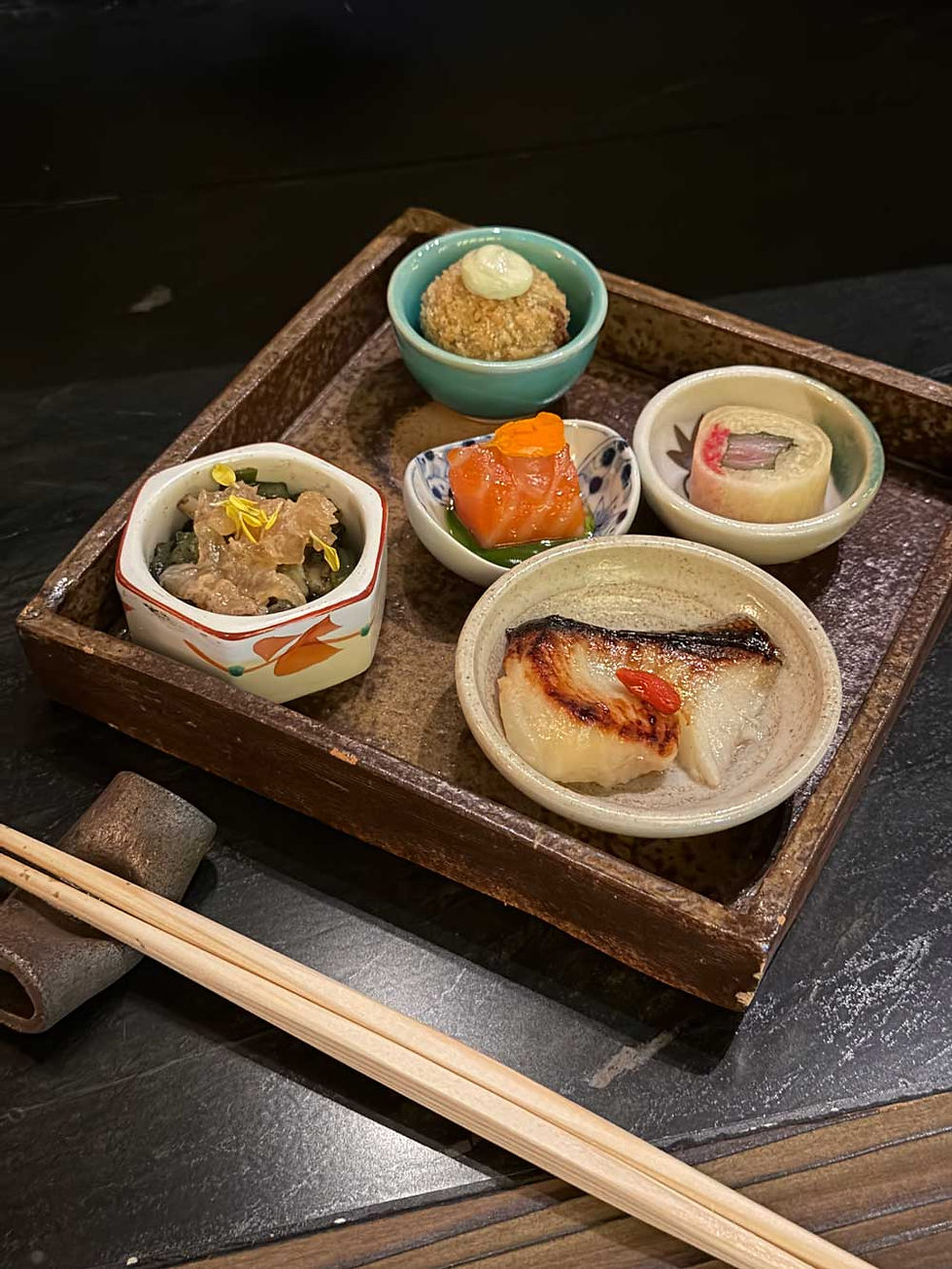
Among the seasonal small dishes, there were familiar things — miso black cod (which I also teach), wagyu croquette (comforting, recognizable as mini-katsu), daikon maki that made me want to start experimenting. And then there was something that slipped past me for years — salmon mi cuit.
I still don’t understand how this term avoided me during my classical training. Possibly, back then I was not listening to the texture that much? Half-cooked, gently set, that exact point where the texture becomes almost unreal — not raw, not cooked, just perfect. That one bite sent me home experimenting. And yes, I got there. That texture is addictive.
SUSHI — NIGIRI
Bluefin tuna akami and otoro

High quality bluefin tuna nigiri, right? But then there are few details.
The akami was brushed with a glossy egg yolk-based glaze — gently cooked sous vide yolk, adjusted with soy, mirin, sake, and finished with yuzu kosho. It didn’t read as a sauce. It read as surface. That little touch changed the bite.
The otoro was torched — something I didn’t expect to enjoy as much as I did. The fat melted into the rice, warming it slightly, changing the experience entirely. Just different and memorable.
NIMONO — WAGYU BEEF CHEEK
Smoked Bourguignon beef cheek, red wine jus, potato foam, black truffle supplement
That's when most of the guests were making videos of their dishes prepared for them. Turn on the sound and listen.
I don't know what solution would I come up with if anybody asked me to turn boeuf bourguignon into a small plate for multi-course menu. It is by itself really cool puzzle to solve.
It wasn’t really a small portion of boeuf bourguignon. It was an idea of it — broken into elements, refined, reassembled in front of you. Each component precise, each one delicious on its own, and together something that felt both familiar and completely new.
This is where the chefs’ background becomes visible without being announced.
YAKIMONO — WAGYU + WAGYU
Miyazaki A5 wagyu, American wagyu, palette of accoutrement
(акУтрома или акУтермнт)
SHOKUJI — TAKIKOMI RICE
fishbone dashi
TOMEWAN — MISO SOUP
nama nori

The wagyu course was meant to be the centerpiece. But what I picked to remember was not the meat. It’s a small, almost hidden element: yakimiso with pecans, the one that holds a rice cracker.
Toasted miso, adapted to Texas, deep, nutty, intensely umami. Something between a condiment and a conversation starter. I didn’t even fully hear the explanation — the room was loud — but it was enough to send me searching, reading, thinking.
All three menu items were served at the same time — wagyu, rice, and miso soup — signaling a conclusion. It's a return to simple, humble culinary roots. The miso soup, interestingly, was completely smooth. No sediment, no need to stir. I don’t know exactly how they achieved that texture, didn't ask. A small technical mystery I’m still carrying with me.
For my friend — the one who invited me to my first omakase at Kappo Kappo — takikomi rice was the best dish of the evening. And I understand why. The chef simply lifted the lid of the donabe, and in that exact moment, a cloud of steam escaped — carrying with it a deep, layered, unexpectidly complex aroma. Before we even tasted it, we already knew this was not just “rice.” When it was served, it came mixed with vegetables and something else I couldn’t quite identify, its color softly creamy rather than white. My friend was absolutely delighted. She asked how it was made, and the answer was simple: the secret is in the fish bone broth.
That made sense to me. I suspect it was the same stock they used for the chawanmushi. At the very least, both dishes depend entirely on the quality and depth of that dashi. When the foundation is that strong, everything built on top of it carries that intensity.
Afterward, I went to look more closely at what takikomi gohan really is. Either I had never encountered the term before, or I had simply passed by it without paying attention. Takikomi gohan is a seasoned rice cooked together with vegetables, seafood, or meat in dashi — a one-pot dish where the rice absorbs everything as it cooks. In a way, I found myself comparing it to pilaf or even paella — rice that becomes something more than a neutral base, something expressive.
For some reason, until that moment, I had always thought that Japanese cuisine didn’t really have an equivalent — that rice there was mostly about plain steamed rice, sushi rice, or something like okayu. Clearly, I was wrong.
KANMI — RICE CREAM
koshihikari rice, junmai sake, rhubarb compote, strawberry foam
PETIT FOUR — MADELEINE
Lemon

Kanmi (甘味) is a Japanese term for "sweetness" or "sweet flavor". In kaiseki, this part of the meal is not meant to overwhelm. It usually leans toward something restrained, balanced, often paired with tea. A soft landing after everything that came before.
Here, it was rice cream — made from koshihikari rice, with junmai sake, and, on the second visit, rhubarb compote and strawberry foam.
I wanted to love it. But this was the only moment in the meal where I felt a drop in craftsmanship. The first time, it was essentially a white ice cream with something like crispy puffed rice — pleasant, but forgettable. The second time, the addition of rhubarb and strawberry foam made it more composed, more intentional, but still not at the same level as the rest of the menu. And that stood out for me.
Because the final dish matters. It is the last impression that lingers, the last note in the conversation. When everything before is so thoughtful, so precise, the ending becomes even more important. It wasn’t bad. Just… not memorable.
Though I will admit — I smiled at the name. That small playful echo: rice cream / ice cream. A quiet joke, almost hidden, like many things in this meal.
I am so Grateful to Kappo Kappo.
For the feeling of being nudged — gently but firmly — out of my routine. To revisit what I already “know,” to notice more, to question more. And occasionally, to smile when a refined French-Japanese bite suddenly tastes like salted herring and fries from childhood.

Comments