
Chawanmushi: A Simple Custard, Made Complicated
It Means Steamed in a Tea Bowl
Chawanmushi (茶碗蒸し) is a classic Japanese savory egg custard—delicate, silky, and deeply comforting. If anything, it always lived somewhere in the corner of my culinary memory—a soft, savory custard you learn once, respect, and move on.
And then it arrived as part of the mushimono course at Kappo Kappo. Mushimono—蒸し物—is simply “steamed things.” But what was placed in front of me that evening had very little to do with modesty.

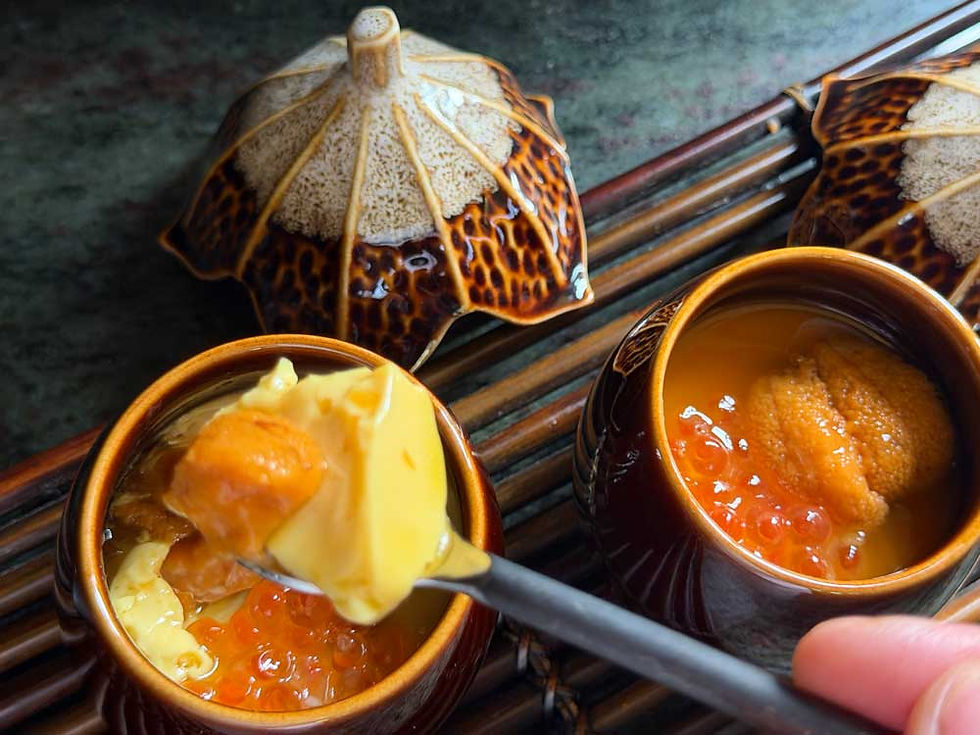
The custard was darker than expected, clearly built on a seafood dashi with depth, with a hint of smoke. Not the pale, quiet version I knew. Golden ikura, uni, and fresh wasabi on top. It was luxurious. The custard carried depth, the roe brought salinity and texture, the uni dissolved into richness, and the wasabi gently woke up the palate.
On my second visit, the chawanmushi was different. The custard that time was… just a custard. Ikura was paired with crab gin-an and something green (seaweed, perhaps), with a touch of wasabi again. This time my attention shifted to the gin-an—that semi-transparent “silver sauce” I had somehow managed to ignore for years. Here, it carried flavor and added a delicate layer of texture.

Somewhere between those two bowls, I realized that chawanmushi had been unjustly forgotten in my kitchen for years.
From Qing Dynasty to Edo Period
Chawanmushi feels unmistakably Japanese—but its roots reach back to China, where cooks have been steaming eggs into soft, savory custards for centuries. Early references to egg cookery appear as far back as the 6th century, but it is in later Chinese texts that we begin to see a clear understanding of what matters here: dilution, gentle heat, and texture.
In Japan, sometime during the Edo period, this idea takes on a new form. The custard moves into a lidded tea cup (or tea bowl—chawan), becomes structured around dashi instead of water, and turns into something more than technique—a small, self-contained course.
And like many dishes that travel, it becomes most precise at the point where it becomes personal.
Chawanmushi Is Simple. And Tricky.
At its core, chawanmushi is eggs, dashi (usually kombu + katsuobushi stock), and light seasoning (soy sauce, mirin, sometimes sake). The mixture is gently combined with chopsticks (never whisked, to avoid incorporating air), strained, and steamed until just set. It should be neither firm nor jiggly like flan. It should feel like warm silk.
This savory custard often hides shrimp, chicken, shiitake, ginkgo nuts, and kamaboko (fish cake), though shiitake tends to float to the top. Mitsuba is the most common aromatic herb. It is said that the element of surprise is part of the experience—you don’t see everything at first glance.
I personally avoid adding raw chicken or shrimp directly into the custard, because it makes controlling doneness more difficult.
Chawanmushi is deceptively simple, but technically demanding.
Temperature control is everything. The level of heat under the pot matters more than it seems. Chawanmushi doesn’t really cook at boiling temperature, even though it sits in a steamer. It lives in a gentler zone where egg proteins set without tightening too quickly. Too much heat, and the custard reacts—bubbles form, the texture turns grainy, the liquid can separate. Lower, steadier heat gives you a custard that barely holds itself together, smooth and silky.
Dashi matters here more than anywhere else. In chawanmushi, it isn’t just a background—it becomes the body of the dish. I used a deeply flavored seafood dashi built from kombu, shiitake, anchovies, and katsuobushi, with a touch of saffron for color and a quiet aromatic lift. The higher the liquid ratio, the more important the dashi becomes. A weak stock will simply disappear. A strong one carries the custard.
Egg-to-liquid ratio matters deeply. A ratio closer to 1:2 (like the one I use) creates a more stable custard—still delicate, but with enough body to feel secure on the spoon. As you increase the liquid to 1:2.5 or 1:3, the texture softens noticeably. These are simply different points on a scale. The important part is understanding that every adjustment shifts both texture and tolerance: the softer the custard, the more precise everything else needs to be.
Straining is non-negotiable. It may feel like a small step, but it’s the difference between home-style and restaurant-level texture. Straining removes chalazae, tiny clumps of protein, and air bubbles introduced during mixing (even by chopsticks). What remains is a perfectly uniform liquid that sets evenly.
Managing condensation is part of the craft. Modern kitchens often solve this by covering the cups with plastic wrap before steaming. It works well and keeps the surface smooth. Traditionally, when using lidded chawanmushi cups, a small piece of cloth is wrapped around or placed under the lid. This absorbs condensation and prevents droplets from falling onto the surface of the custard. Without that protection, even a few drops of water can leave marks, disrupt the texture, or create small craters. It’s a small detail—but this dish is built on small details.
Chawanmushi with Uni and Ikura

Ingredients (2 servings)
Custard
55 g egg
110 g dashi
½ tsp mirin
¼ tsp sea salt
¼ tsp soy sauce
Toppings
2 pieces uni
2 tsp ikura
Gin-an (silver sauce)
50 g dashi, cold
½ tsp soy sauce
¾ tsp mirin
1 pinch salt
1/2 tsp starch
Instructions
Prepare the custard. Prepare the steamer and cups. Bring water to a gentle boil. Using chopsticks, combine the egg with seasoning. Strain through a fine sieve. Pour into cups and cover with plastic wrap. Steam over medium heat for about 15 minutes, until just set.
Prepare the gin-an. In a small saucepan, combine all ingredients and cook briefly until lightly thickened. Alternatively, this can be done in the microwave (about 1 minute for a small portion).
To serve. Remove the cups from the steamer and uncover carefully. Pour a small amount of warm gin-an over the custard. Top with uni and ikura. Serve hot, warm, or even slightly chilled.
You can find and save this recipe in my Samsung Food collection if you prefer cooking from your phone.
Nutrition Facts (approximate, because life is not a lab)
Serving Size: 1 portion (1 cup chawanmushi with toppings)
Calories: ~140–180
Protein 9–11 g Total Fat 7–9 g (9–12% DV) Saturated Fat 2–3 g (10–15% DV) Cholesterol ~220 mg (73% DV) Sodium ~500–650 mg (22–28% DV) Iron ~1.5 mg (8% DV) Vitamin B12 ~2.5 mcg (100% DV) Choline ~250 mg (~45% AI)
Ingredients & what they do
Eggs provide the structure—gentle protein coagulation that creates the custard itself, while also delivering choline and B12, both essential for brain function and metabolism. Dashi acts as both liquid and flavor foundation, bringing umami without heaviness, allowing the custard to remain light yet deeply satisfying. Uni contributes richness and oceanic sweetness, adding both fat and micronutrients, while ikura introduces bursts of salinity and texture, along with omega-3 fatty acids. The balance here is quiet but intentional: protein, minerals, and umami working together in a form that is easy to digest and surprisingly nourishing.


Comments