
Mi Cuit: Intentionally Interrupted
The term itself isn’t a modern invention or a clever name that appears in a restaurant menu. It comes from the language. French had expressions like à demi cuit already in the 17th century, which simply meant “half cooked” in the most literal sense. Over time, that idea settled into the form we use now: mi cuit. Not a dish, not a technique—just a way to describe a state.
Technically, it’s very straightforward. Something is heated enough for change to begin. Proteins start to denature, structure begins to shift, texture moves away from raw. But the process is interrupted before it becomes what we would normally call cooked. It’s not undercooked. It’s intentionally incomplete.
Before sous vide and how it became modern
Long before precise temperature control, cooks still knew how to stop early. They relied on ways of applying heat slowly and evenly enough to control the result: bain-marie, steam, cooking in parchment, slow roasting, poaching wrapped in cloth.
Foie gras is one of the clearest examples. In French cuisine, foie gras mi cuit became its own category: not raw, not fully cooked, but softly set, almost spreadable. French culinary guidance still describes these traditional approaches in detail. There are even official specifications defining foie gras mi cuit as a distinct product.
Aren’t we doing this mi cuit already?
If mi cuit means stopping the cooking process before something becomes fully cooked, then it sounds familiar. A medium-rare steak is not fully cooked by design. The same is true for eggs. A soft-boiled egg, a poached egg, even a fried egg with a runny yolk — each of these exists because we choose not to cook it further.
So why don’t we call them mi cuit?
Steaks and eggs are not seen as incomplete. They are complete in their own categories. They are expected. Mi cuit seems to appear in a different context. It describes a state where something is held just before it reaches what we expect that ingredient to become.
This may be why we see it so often with fish. Fish already exists on both sides of the line. We are comfortable eating it raw, and we are comfortable eating it cooked. That makes the space in between not only possible, but interesting. Salmon, tuna, sometimes mackerel and sea scallops — these are ingredients that can hold that ambiguity without resistance.
So maybe it has less to do with temperature, and more to do with expectation. Not everything that is stopped before full doneness is called mi cuit. Eggs, steaks, and other foods have their own language for that. But with certain ingredients, especially fish, French cuisine chooses a different word, one that reflects that space before expectation is fulfilled.
A note on safety
And this is where things become less poetic.
In the United States, the FDA requires fish that will be eaten raw or only partially cooked to go through parasite destruction—usually freezing at specific temperatures and times. In Europe, the rules are similar. If fish is not fully cooked, it must be frozen under controlled conditions unless it falls into specific exemptions. And when it comes to actual cooking, both systems point to much higher temperatures—around 63°C—as the standard for fully cooked fish.
Which means that very low-temperature fish, the kind that sits somewhere in that mi cuit space, is not made safe by the cooking itself. Safety has to be addressed before that moment, not during it.
Finding my mi cuit
It was at Kappo Kappo. A tiny plate. A small square of salmon, barely a bite. Soft, room temperature, fragile in a way I hadn’t experienced before. That texture stayed with me.
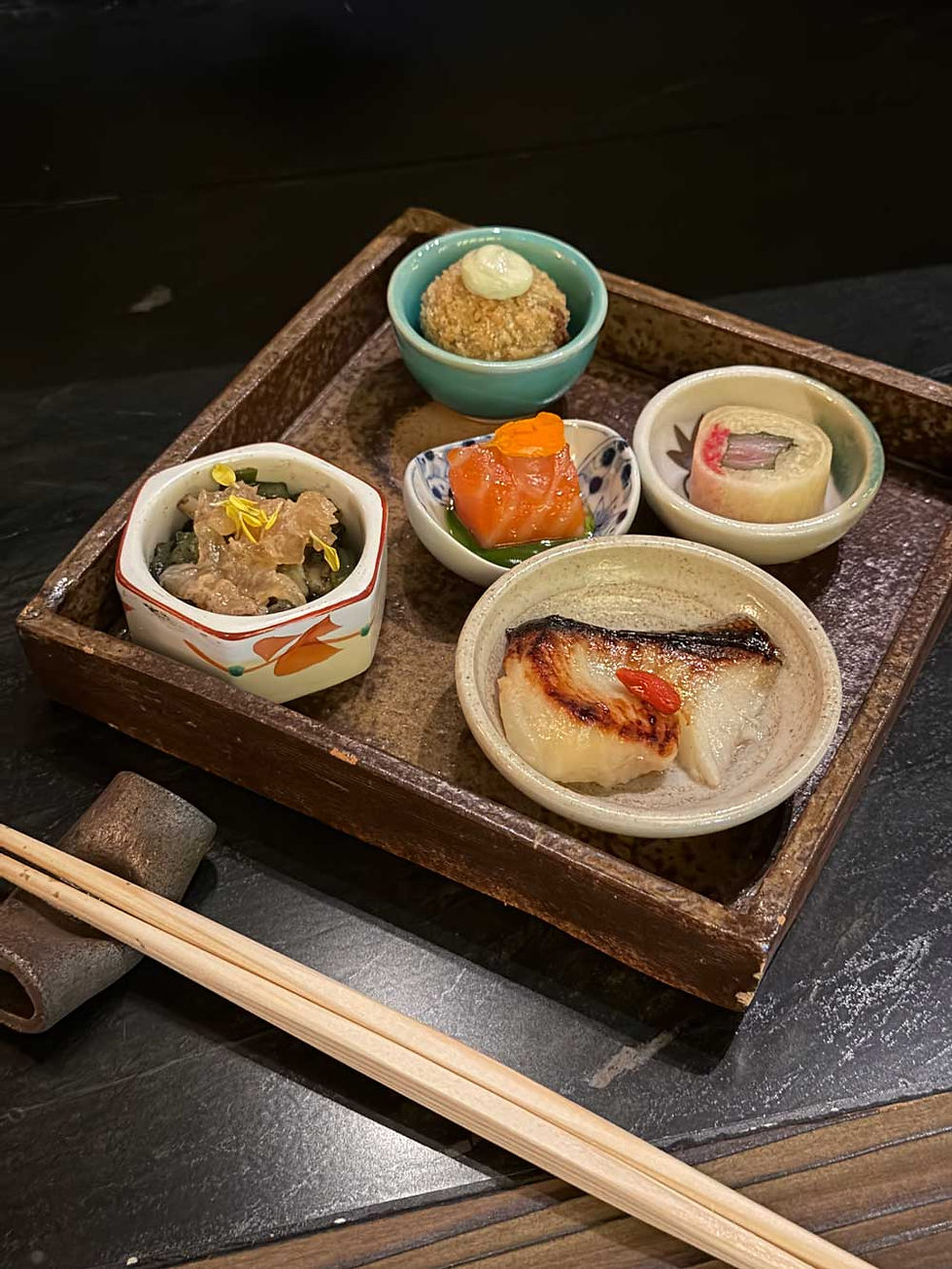
At home, a quick search led me to the ChefSteps method using sous vide, and it felt like the obvious path. At 41–42°C for an hour, the result was almost unsettling in its delicacy. The fish didn’t move toward doneness. It simply crossed a line.
From there, I started wondering what else could live in that space. Mackerel, of course.
I also wanted to find my own way to serve it. Not just the fish, but what belongs next to it. What kind of sauce, what kind of base, what kind of texture would support it without overwhelming it.
Right now, my answer is very simple.

Salmon or steelhead mi cuit (recipe below). Eggs cooked at 64°C for about an hour, until the whites are set and the yolks hold their shape but remain soft. A small amount of kosho for sharpness. Something fresh. Something crisp.

With mackerel, I like a spoonful of okayu underneath—soft, warm, almost neutral, letting everything else speak. A small amount of umeboshi paste. Maybe later, thin slices of cucumber or radish. Green onion or chives for something familiar. A bit of sesame or furikake for texture.
Nothing more.


Comments