
Sea Scallops Under a Crisp Pastry Dome — The Life of a Recipe
Let's Start from the End
In February, I visited California.
Three days in Sonoma Valley. Two birthdays — mine and my longtime friend’s. We rented a house, cooked, laughed, tasted wine, and on her birthday we went to dinner at Valette in Healdsburg.
One of the appetizers arrived in small metal saucepans, sealed with baked pastry domes. The crust had been brushed with squid ink before baking. As it expanded, it cracked into a delicate web of fissures.

When the server sliced through the crust, aromatic steam escaped — dramatic but intimate. The domes were turned upside down, divided so each person received a single scallop, sauce spooned over.
Even the photos look impressive.
But what stayed with me wasn’t just the dish.
At some point during the evening, an older gentleman stopped by our table. Calm, warm, observant. He asked how we were enjoying dinner. That was Bob Valette.
On one of the walls hangs a picture of his airplane. Bob used to fly firefighting missions in Sonoma County. Even today, driving through the valley, you see signs asking: Do you know your fire escape route? And here he was — walking the dining room.
When the scallops arrived under their pastry domes, Bob told us that his son, Chef Dustin Valette, had invented that presentation about twenty years ago.
Twenty years.
Think about that.
A dish that has survived trends, reinventions, investors, and relocations. A dish still alive because it works.
Before you continue, jump to this article at Sonoma Magazine Valette Celebrates Its First Decade in Healdsburg. "Chef Dustin Valette talks gray hair, why scallops are a permanent fixture on the menu and the special role his dad plays in the dining room."
The Evolution of my Sea Scallop Recipe
I, too, have a scallop recipe with a history.
It began as a fish galette.
Then I wanted more. I wrapped sea scallops and lobster tails inside it, with crème fraîche and wild ramps purée. I was in my “ramps preservation” era. I made annual batches. I was extravagant.

The galette was beautiful, wasn't it?
The problem? Scallops release ocean. And ocean softens pastry. The dough surrendered too quickly.
So I transformed the idea. Instead of a galette, I began baking the scallops in small terracotta portion pots. Dough on the bottom — because pastry soaked in cream sauce is divine. Dough on top as a lid.
And yes — it was rye pastry.
Rye has very little gluten. It doesn’t stretch; it fractures. It refuses theatrical inflation. So instead of letting steam fight the dough, I controlled it. I made a small cross cut in the center to release pressure and keep the crust flat, crisp, and deliberate.
That version worked.
I haven’t made those pots in years. Until I saw Valette’s sea scallop appetizers.
The Crusty Dome Technique — The Magic Is Steam
As delicious as my rye version was (add a glass of brut or rosé and it becomes a celebration), it never photographed well. The pictures couldn’t capture the pleasure. They looked… blah.
So I never really showed it.
I would probably still be making my scallops and lobster tails under a rye crust — happily, privately — if not for the reaction my Facebook followers had to Chef Dustin Valette’s dramatic pastry dome. A few comments asking for the recipe nudged me into experimentation mode. Could I recreate the dome in my own kitchen?
Let’s Begin with the Dough
Because beyond the presentation, the method is surprisingly simple. What makes the dome rise? Steam.
The filling must contain enough liquid to generate vapor quickly. The vessel must conduct heat from below before going into the oven. If you start directly in the oven, the dough begins to set before it has time to inflate properly. That first burst of bottom heat is crucial.
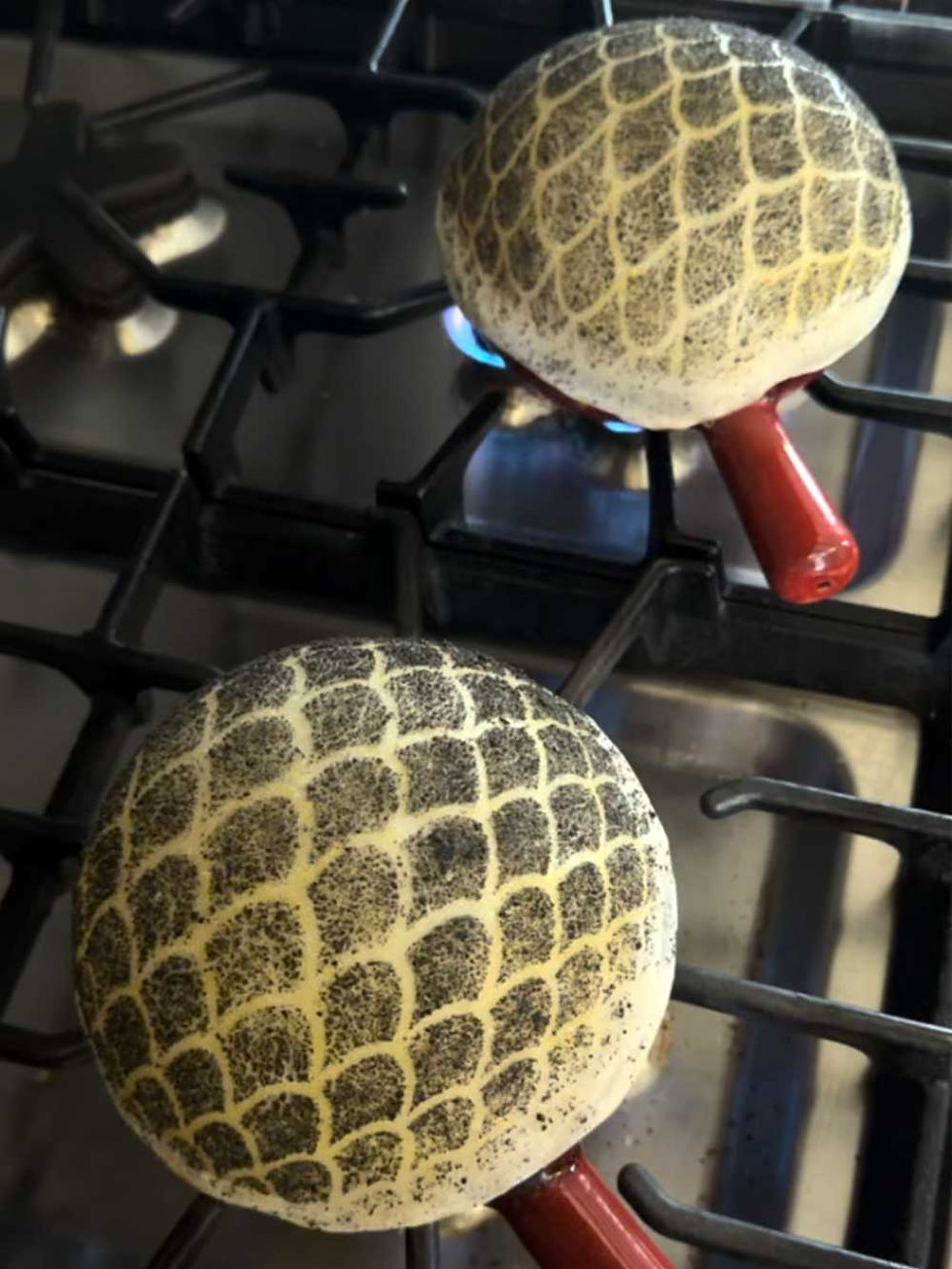
At Valette they use metal saucepans. I use 2-inch-high, 5.5-inch-wide terracotta pots.
Any heat-safe vessel that can be preheated from below will work.
What About the Dough?
There are variations.
The photo published in Sonoma Magazine shows the dish made with puff pastry. It looks slightly different from what we were served that night. Puff pastry produces a beautiful, layered crust — deeply flavorful and shatteringly crisp — but it doesn’t stretch into a high dome the same way a more elastic dough does.
There are also practical considerations in professional kitchens. Puff pastry is more labor-intensive and ingredient-heavy — and more expensive for home cooks. A lean, high-hydration dough can be more predictable, more economical, and easier to scale.
In a restaurant setting, consistency matters as much as drama. In a home kitchen, we get to choose. And that’s where things become interesting.
Sea Scallops Under a Crisp Pastry Dome Recipe
(Serves 2 — 1 pot per person)
My pots are 2 inches high and 5.5 inches wide. I usually cook 3 giant sea scallops per pot. Adjust the quantities to fit the size and depth of your own cooking vessels.
For Crisp Pastry Dome (Part 1 — Dough)
Ingredients:
75 g all-purpose flour
6 g butter
1 pinch salt
40 g boiling milk (or water)
In a bowl, combine the flour and salt.
Place the butter in the center. Pour the boiling milk over it and quickly mix into a dough.
Knead briefly until smooth — this takes less than a minute.
Divide into two portions, cover, and let rest for 10–15 minutes.
For Sea Scallops Filling
Ingredients:
6 giant sea scallops
4 gumbo shrimp, cleaned (optional)
2 tbsp butter
5-6 carrot coins
1/2 shallot, thinly sliced
1/4 fennel bulb and a few fronds, thinly sliced
1 garlic clove, thinly sliced (optional)
Salt, white pepper
1 tbsp white or rose wine (optional)
Generously butter the bottom and sides of each pot.
Layer the vegetables first — they should form a light aromatic base, not a bulk.
Place scallops (and shrimp, if using) on top.
Season lightly with salt and white pepper. Add wine if using.
For Crisp Pastry Dome (Part 2 — Assembly & Decoration)
Ingredients:
1 egg yolk
1/4 tsp cold water
1 tbsp nigella seeds
1 tbsp black sesame seeds
pinch of salt
Grind nigella and black sesame seeds together with a pinch of salt into a fine powder.
Roll each portion of dough into a round large enough to fully cover and seal the pot.
Mix egg yolk with water to make an egg wash.
Brush a thin layer of egg wash over the dough, leaving about 1 inch border clean.
Place a stencil over the dough and sprinkle the seed powder evenly. Remove the stencil.
Brush the outside rim of the pot with egg wash.
Place the dough on top and press firmly to seal.
Cooking Method
Preheat oven to 400°F.
Place sealed pots on the stovetop over medium heat.
Heat until the dome inflates and lifts into a rounded shape (this may take a few minutes depending on starting temperature, be patient).
Immediately transfer to the oven.
Bake for 8–10 minutes, until the crust is golden.

Serving
Here is the sea scallops under a crisp pastry dome.
Bring the pot to the table.
Cut through the crust.
Steam escapes. Aroma blooms. Magic happens.

Nutrition Facts (approximate, because life is not a lab)
Serving Size: 1 terracotta pot (3 giant scallops + 2 gumbo shrimp + vegetables + pastry dome)
Calories: ~440–460 kcal Total Fat 19–21 g (24–27% DV), Saturated Fat 9–11 g (45–55% DV), Sodium ~450–550 mg (20–24% DV), Total Carb. 35–39 g, Fiber ~2 g (7% DV), Protein 28–31 g, Iron ~15–20% DV, Vitamin B12 ~70–90% DV, Choline ~165–190 mg (AI ~30–35%)
Ingredients & what they do
Sea scallops and shrimp make this dish protein-forward in a very elegant way. Scallops bring lean, high-quality protein, while shrimp deepen the seafood flavor and add even more protein and vitamin B12. Together they make the dish feel rich and celebratory without actually being heavy.
The aromatic base — shallot, fennel, carrot, garlic, and fennel fronds — is used lightly, more as perfume than as bulk. It does not dramatically change the macros, but it adds a little fiber, a little sweetness, and the kind of savory complexity that makes the buttery juices in the pot taste fuller and more alive.
The pastry dome is where texture, drama, and much of the carbohydrate content come from. Flour gives structure, butter adds tenderness, milk contributes a bit of protein and B12, and the egg yolk adds color, richness, and a meaningful amount of choline. The seed topping contributes a little extra iron, fiber, and nutty depth, even in a small amount.
This version reflects how you cook for yourself right now: still luxurious, still theatrical, but more directly centered on seafood and structure than on sauce. Protein-forward, crisp, aromatic, and grounded in pleasure.
What I Learned While Getting This Right
I thought this recipe was finished a few weeks ago. All that was left — cook it one more time, take beautiful photos, film a video, publish. In reality, it took me five or six more attempts to get everything where I wanted it: reliable, approachable, not overly complicated — and still impressive.
I overestimated my instincts a few times, and practice corrected me. Here’s what I learned:
Effect of scallop quantity
Limiting the pot to about three large sea scallops is crucial. More scallops release enough liquid to create strong steam pressure. That steam turns into foam and can break through the dough, tearing the dome. If you want more seafood, add a few shrimp or pieces of firm fish — they give volume without overwhelming the structure.
Choice of vegetables
Thin slices of carrot, fennel, and shallot cook quickly and add sweetness and aroma.
These are aromatics, not a filling. They should perfume the dish — not take it over.
Fat variations
Butter works best. It melts, emulsifies with the scallop juices, and creates that light, glossy sauce at the bottom. You can use crème fraîche or a splash of heavy cream for a softer, rounder result. A neutral oil will work — but you will lose some depth.
Liquid additions
A small splash of wine adds brightness and keeps the sauce from feeling too rich. Too much liquid, however, will dilute flavor and create excess steam — and that brings us back to broken domes.
Flour substitutions
You can replace 15–20% of the flour with rye or buckwheat for flavor and color. More than that, and the dough loses elasticity. Less gluten means less stretch — and a higher chance of tearing under steam. Whole-grain flours also absorb more liquid, so adjust slightly if needed.
Decorations
Squid ink looks dramatic — but in practice, it’s expensive, messy, and not very forgiving. The stencil with ground nigella and black sesame turned out to be the simplest and most reliable solution. And once the dough stretches, the pattern becomes beautifully imperfect.
Serving
Serve it as is — that moment when the crust opens is part of the experience.
Or spoon Champagne Beurre Blanc over the scallops. Or my Cream of Ocean Sauce, a version of French classic. For a celebratory touch, add salmon roe, caviar, chopped chives, or microgreens. Just a little garnish — and it becomes a celebration.


Comments