
Green Peas, Seriously
A curious look at a very familiar ingredient — through culture, science, and three dishes I keep repeating
I recently stumbled upon an English-language video where a well-known doctor was enthusiastically praising green peas. You know the type: confident tone, miracle-adjacent wording, the kind of thing that makes you smile skeptically and scroll on. Except I didn’t. I laughed — and then I went digging.

What I found was unexpectedly satisfying. The research exists, it’s not new, and it’s not exaggerated: green peas really are nutritionally impressive. Protein — unusually high for a vegetable. A lot of fiber. Folate, vitamin K, polyphenols, carotenoids. A stable blood sugar response. Gut-friendly starches. Nothing mystical — just solid, well-documented facts.
What surprised me most, though, was how much of that goodness survives even in canned young peas. Which I already loved — not for their health halo, but for their taste, texture, and the fact that they’re always there when I need a quick side for “something.” So I thought: instead of chasing novelty, why not build something a little more intentional out of what I actually use?
Before cooking, I did what I always do when an ingredient grabs my attention: I looked around the world. Green peas are often described as native to the Mediterranean, and the culinary map supports that idea beautifully. The closer you are to that epicenter, the more minimalist the preparations become — peas as the main character, barely dressed. As you move north, peas meet smoked or cured pork — and then potatoes. In colder climates, they appear both as dry dishes and soups. When meat disappears, fat steps in — butter, crème fraîche, sour cream — logical, economical, comforting.
India, predictably, turned out to be a universe of its own. I expected some abundance; I didn’t expect the scale. Aloo matar, everywhere — endlessly reinvented. Matar paneer built exactly like palak paneer, sometimes even with a smoked note. At some point, you start wondering who borrowed from whom — the British from India, or the other way around — and then you realize it doesn’t really matter. The pairing works.
That’s how these three recipes came together — not as a planned menu, but as a trail of curiosity.
First, I reached for what was practical and familiar — a composed salad inspired by what was already in my fridge and pantry, like canned green peas, smoked turkey breast, and, luckily, a fennel bulb.
Then there was Portugal. Ervilhas com Ovos Escalfados — I tried to pronounce it. Failed. Laughed. The combination of ingredients was something new to me. But it made immediate sense: green peas gently simmered with aromatics, eggs poached right in the peas, yolks enriching the broth already flavored with chorizo. It should be Mexican in Texas, I thought!
And finally, I found a culinary trend that’s sweeping post-Soviet kitchens: festive winter salads are going viral in entirely new forms: as Noel rolls and savory cakes and pastries, often built on a vivid green pea sponge.
Each of these dishes reflects a different way of thinking about peas — not just as a quick side, but as something you can build a meal around.
Recipe 1 — Canned Green Pea & Smoked Turkey Salad with Fennel
I made this salad first, drawn by simplicity and the pleasure of working with ingredients I actually keep at home. It’s a composed salad that treats humble canned petit peas with a bit of respect, and it has become one of those repeat dishes I make almost on autopilot.
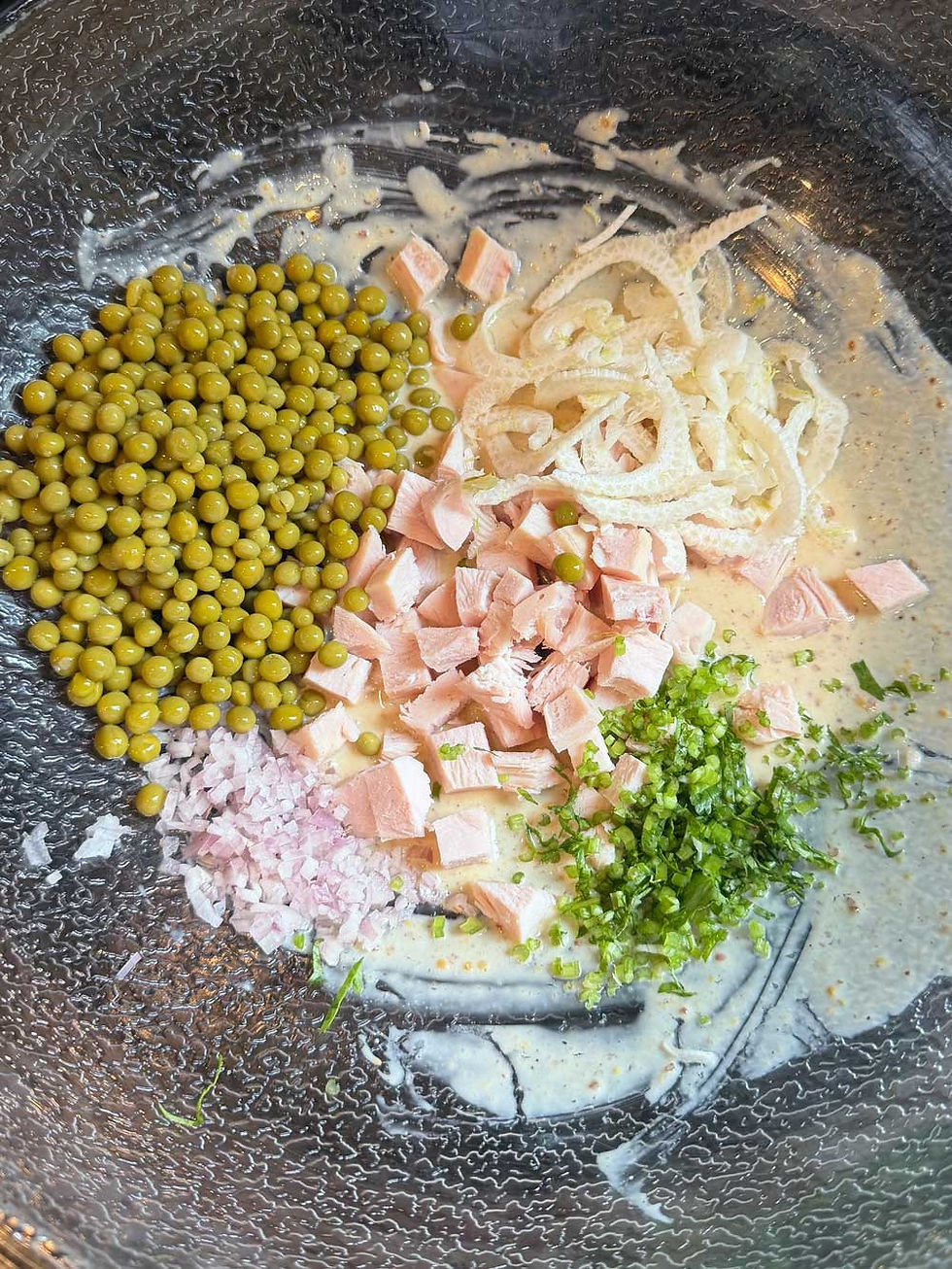
It’s also endlessly adaptable. The protein can be smoked turkey, roast chicken, or a lean ham. Fennel adds a beautiful anise crunch, but fresh apple, pear, or thinly sliced radish work just as well — which means the salad is never quite the same twice.
Ingredients (1 generous serving)
100 g / 3.5 oz smoked turkey breast (or other lean poultry or ham), diced
100 g / 3.5 oz canned young green peas, drained
20 g / 0.7 oz shallot, finely diced
40 g / 1.4 oz fennel bulb (or apple, pear, or radish), very thinly shaved across the grain
1 tbsp finely chopped cilantro stems
Dressing
zest and juice of ½ lemon
5 g / 1 tsp Dijon mustard
5 g / 1 tsp whole-grain mustard
5 g / 1 tsp honey
15 g / 1 tbsp skyr (Greek yogurt, labneh, or sour cream all work)
2.5 g / ½ tsp extra-virgin olive oil
salt and black pepper, to taste
Instructions
Whisk all dressing ingredients until smooth. Add the turkey, peas, shallot, fennel, and cilantro stems. Mix gently, taste, adjust, and serve piled high. This is a full meal — light, but not fragile.

Nutrition Facts (approximate, because life is not a lab) Serving Size: 1 bowl (≈ 280 g) Calories 310, Total Fat 8 g (10 % DV), Saturated Fat 1.5 g (8 % DV), Total Carb. 18 g (7 % DV), Dietary Fiber 6 g (21 % DV), Total Sugars 7 g, Protein 29 g (58 % DV), Sodium 540 mg (23 % DV).
Ingredients & what they do: Green peas support gut health and steady blood sugar through fiber and resistant starch. Smoked turkey provides lean complete protein. Skyr adds protein and a creamy texture with minimal fat. Olive oil improves absorption of fat-soluble phytonutrients. Lemon and mustard quietly help iron absorption from peas.
Recipe 2 — Ervilhas com Ovos Escalfados (with Mexican Chorizo)
During my reading, I came across Ervilhas com Ovos Escalfados — literally Portuguese peas with poached eggs — a home-style dish often made with peas, smoky sausage (chouriço), and eggs poached right in the flavorful base.
I tried it first with Spanish chorizo; the particular sausage I picked overwhelmed the peas. I switched to Mexican chorizo, which is easily available here in Texas, more affordable, and just makes more sense where I live. (They are two completely different products, in case you don't know!) Mexican chorizo dissolves into the sauce instead of staying in firm chunks, creating a beautifully integrated flavor profile. Its chili-garlic-cumin profile integrates naturally with peas. The result felt grounded, coherent, and deeply comforting. That’s the version I kept repeating, delighted each time.
Ingredients (serves 2)
130 g / 4.6 oz Mexican chorizo
40 g / 1.4 oz shallot, finely diced
1 large clove garlic, minced
300 g / 10.5 oz frozen green peas
60 ml / ¼ cup light stock
4 eggs
black pepper, to taste
salt, cautiously
Instructions
If your chorizo is in natural casing, slice it to bite-size pieces. If not, remove the casing. I use individual 6" frying pans to make each portion and divide the ingredients equally. Start the chorizo in a cold pan and cook gently, rendering the fat. Add shallot and garlic and cook until soft and aromatic. Add peas and stir until bright green. Pour in the stock and let everything simmer briefly. Make small wells in the peas, crack in the eggs, cover, and cook until whites are set and yolks remain soft.

Nutrition Facts (approximate, because life is not a lab) Serving Size: 6" pan portion Calories 410, Total Fat 27 g (35 % DV), Saturated Fat 9 g (45 % DV), Total Carb. 20 g (7 % DV), Dietary Fiber 7 g (25 % DV), Protein 24 g (48 % DV), Sodium 760 mg (33 % DV).
Ingredients & what they do: Green peas contribute fiber, folate, and steady energy. Eggs complete the amino-acid profile and provide fat-soluble vitamins. Chorizo supplies flavor and fat — easily adjustable without breaking the dish.
Recipe 3 — Savory Green Pea Sponge (for Savory Noel Rolls and Cakes)
Across post-Soviet countries, familiar holiday salads like Shuba, Olivier, and Mimosa are going viral in entirely new forms: as savory Noel rolls and savory cakes. It’s playful, nostalgic, slightly theatrical — and some of these constructions start with a pea-based sponge that acts as a base for salads or cake layers.
While English-language food media has sweet pea cakes and pea-infused desserts, I couldn’t find anything comparable as a savory multi-layer base incorporating peas. That makes this technique unusually distinctive — and worth sharing.
Ingredients
250 g / 8.8 oz frozen green peas
3 egg yolks
3 egg whites
50 g / 1.8 oz all-purpose flour
5 g / 1 tsp salt
5–10 g / 1–2 tsp dry egg whites (albumen powder)
Instructions
Cover peas completely with boiling water and let stand 15–20 minutes. Drain thoroughly. Purée until smooth.
Add salt and dry egg whites to the fresh egg whites and whip until firm. Without sugar, savory meringue is naturally unstable; added albumen makes it workable and reliable.
Mix yolks into the pea purée, then the flour. Gently fold in the meringue, preserving air.
Spread evenly on a parchment-lined tray and bake at 185 °C / 365 °F for 11–12 minutes, just until set. Cool completely before rolling or layering.
This sponge pairs beautifully with herbed whipped cheese, skyr-based creams, lightly salted salmon, smoked fish, or classic potato salad ingredients.
Nutrition Facts (approximate, because life is not a lab) Serving Size: 1/6 sheet Calories 110, Total Fat 2 g (3 % DV), Total Carb. 15 g (5 % DV), Dietary Fiber 3 g (11 % DV), Protein 7 g (14 % DV), Sodium 190 mg (8 % DV).
Ingredients & what they do: Green peas provide fiber and plant protein. Eggs give structure and amino-acid balance. Albumen improves foam stability without sweetness. Flour provides minimal structure without heaviness.
A short, honest note on peas as food
Different forms of peas are not nutritionally identical. Fresh and frozen peas retain more vitamin C and polyphenols; canned peas lose some of that but still bring fiber, folate, vitamin K, and minerals. Dried peas are another category — great for soups and stews, but different in nutrient emphasis.
Understanding what you’re working with matters more than perfection.
Green peas don’t need exaggeration. They just need to be looked at again — calmly, curiously, and deliciously.
For the curious: research & reading — science on peas (and good things they do)
(These point to peer-reviewed evidence about nutrients and benefits.)
Protein and fiber — Peas are unusually high for a vegetable, supporting satiety and stable blood sugar. Study: https://ods.od.nih.gov/factsheets/Protein-Consumer/
Vitamin K & Folate — essential for bone health, cell repair, and homocysteine balance. Study: https://pubmed.ncbi.nlm.nih.gov/22415970/
Carotenoids & polyphenols — antioxidants that support eye health and reduce oxidative stress. Study: https://pubmed.ncbi.nlm.nih.gov/30760694/
Resistant starch (especially in pea purées) — feeds beneficial gut bacteria. Study: https://pubmed.ncbi.nlm.nih.gov/23208552/
Take-away: Green peas support steady blood sugar, feed the gut microbiome, and contribute micronutrients many modern diets lack. Different forms — fresh, frozen, canned — retain different parts of this spectrum, which is not a flaw but an invitation to cook with awareness.
(All nutritional values in this post are estimated averages — because real life tastes better than a laboratory.)


Comments